
Radio as a Human Bond
All the Light We Cannot SeeThis flow traces radio’s role as a medium of intimacy, memory, propaganda, resistance, and recognition.
increasing Bearing strength in each event
 decreasing
Bearing strength in each eventdecreasingAn Orchestra in the Attic
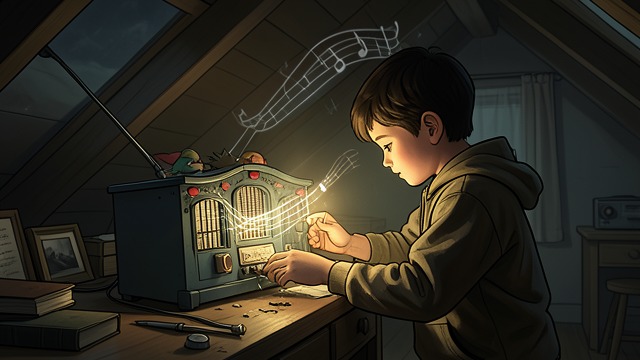
An Orchestra in the Attic
First reception
Werner repairs a radio and hears music that seems to fill the room with an invisible orchestra.
A new imagination
The signal proves that distant voices can cross walls and borders, offering an orphan an opening onto an unknown world.
Radio begins as wonder before the state turns it into a tool of control.
A Voice Beyond Borders

A Voice Beyond Borders
Lessons at night
Werner and Jutta listen to a French speaker describe light, coal, and scientific ideas in a voice that reaches them across distance.
Intimacy through sound
The speaker becomes a trusted presence even though the children do not know his name or location.
The broadcasts show how communication can create belonging without physical contact.
The State’s Single Mouth

The State’s Single Mouth
Information narrowed
German broadcasts celebrate national unity and present fabricated enemies as threats. Foreign listening becomes dangerous and is eventually prohibited.
Werner’s divided response
He recognizes the power of radio but still accepts an institutional path that depends on the same machinery of control.
The medium is neither inherently liberating nor oppressive; its purpose depends on who controls the signal.
A Transmitter for Resistance
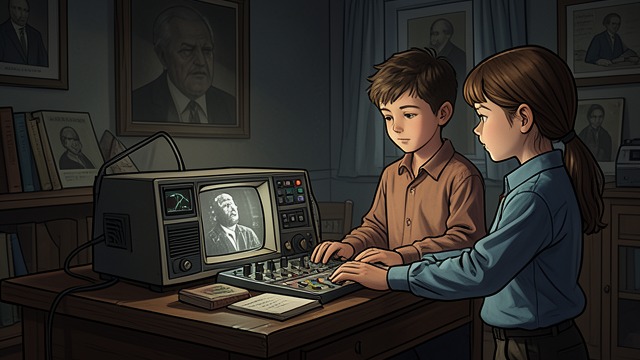
A Transmitter for Resistance
Messages carried secretly
Etienne uses the attic transmitter to relay numbers and civilian messages carried through bread deliveries.
Music alongside information
He also broadcasts short pieces of music, preserving a private language of beauty within a dangerous network.
The transmitter connects practical resistance with the human need to be heard.
A Broadcast That Saves

A Broadcast That Saves
A story reaches Werner
Marie-Laure reads aloud over the transmitter. Her story and urgent warning reach Werner in the cellar beneath the hotel.
Action through listening
Werner responds to a voice he could have dismissed as interference. The broadcast helps him decide to leave the rubble and find her.
Listening becomes an ethical act: he recognizes a specific person rather than an abstract signal.
Around 1934, when Werner repairs his first radio
Mid-1930s, during the French science broadcasts
Late 1930s to 1940, as propaganda dominates German radio
1942, during clandestine broadcasts from Saint-Malo
August 1944, during the siege
